Neurodegeneration Treatment and Prevention
Let me start by saying that the countries that produce kratom, like Thailand, Malaysia, Vietnam, and Myanmar, are countries where kratom is illegal to the local residents. The biggest problem with kratom happens when you combine it with something that interacts negatively with it. In Thailand and other Southeast Asian countries, kratom is often combined with other drugs that are mixed together to produce a deadly combination. But is kratom illegal because of this problem or are there other forces at work?
A more likely reason why kratom is illegal in these countries is because it is a profitable export product. Restricting local use of kratom means more product is available for export to richer countries. What an incredibly unfortunate thing to do to the local people who used kratom for centuries as a sacred medicine. Recently, the Thai National Assembly made kratom legal for medicinal purposes, a sign that this herbal remedy might make a come-back in Southeast Asia, albeit with restrictions to protect people from using it with other drugs that can be deadly in combination with kratom.
But we’re presenting these thoughts merely to balance out some of the propaganda that exists in regard to this amazing plant medicine. Kratom still requires respect and learning to use it properly. Like all medicines, at the wrong dose, it can be toxic and if you combine it with other drugs or herbs without doing your research into potential drug interactions, kratom may produce negative side effects or even death.
Click here to schedule a health coaching session with us.
That being said, if I had a loved one with dementia, I would look closely at kratom as something that could help with pain and also preventing and reversing neurological damage.Diseases like Alzheimer’s, MS, ALS, and Parkinson’s respond positively to treatment with kratom as a result of its effects on the opioid receptors. Kratom has partial mu-opioid receptor agonist effects as well as some kappa-opioid, and delta-opioid effects as well. While drugs like morphine have total mu-opioid effects and also effects involving the beta-arrestin-2 pathway, kratom does not provoke the beta-arrestin-2 pathway, which means that it does not cause respiratory arrest even at mega-doses, and it also does not fully insert itself into the mu-opioid receptors which makes it far less addictive and yet still powerful as a pain-killing agent.
Click here to buy Kratom.
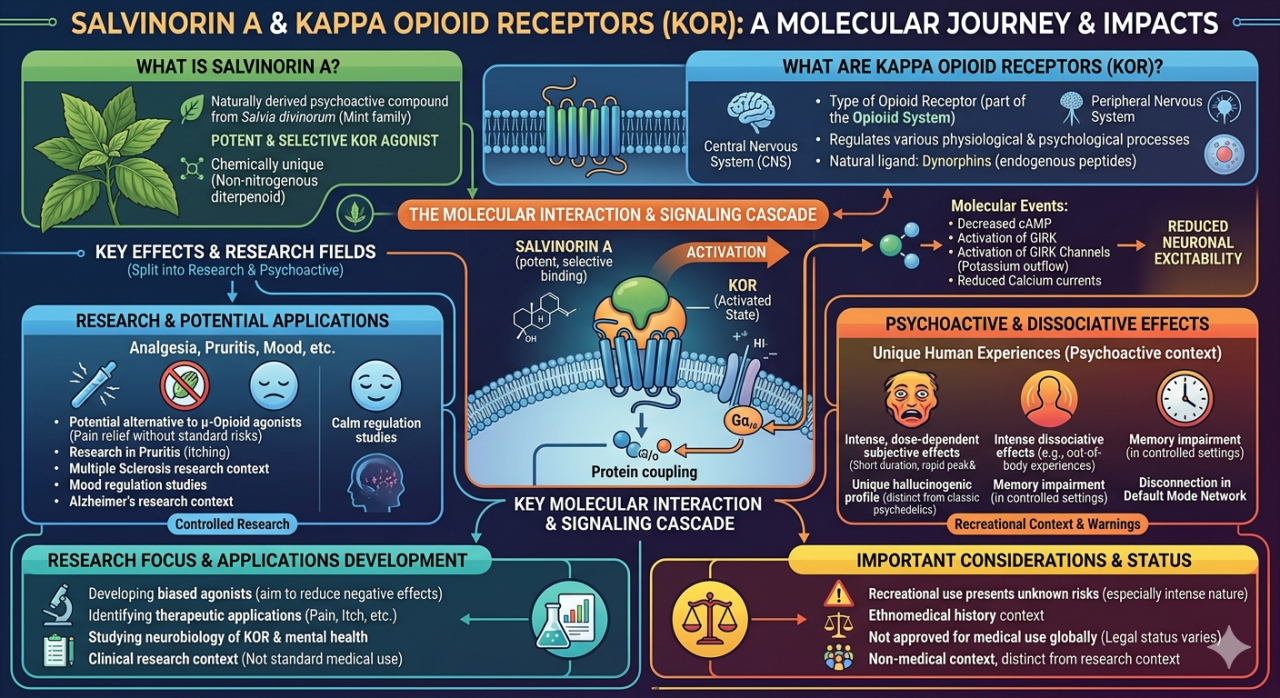
Salvia divinorum is a sacred medicine with psychedelic effects. This medicine produces psychedelic experiences that are entirely separate from consensus reality in a place that some people have dubbed The Land of the Dead. This space is governed by a female deity who seems to preside over paradoxical experiences and situations. She has been called Ska Pastora and also, The Virgin Whore.Salvia divinorum works intensively with the kappa-opioid receptors and this medicine is also well-known for its ability to cure MS and halt the progression of other neurological diseases. Mitragyna speciosa / kratom also functions as a partial kappa-opioid receptor agonist. Indeed, kratom interacts with delta-opioid receptors as well and scientists have speculated that this plant medicine has the ability to modulate opioid receptors. But let’s consider Salvia divinorum and kratom together just a bit more in an effort to better understand kratom and its kappa-opioid function better.
As a partial kappa-opioid agonist, kratom can sometimes cause feelings of dysphoria. Dysphoria is a feeling of intense awkwardness or a sense of being wrong or bad as a person or in regard to something that you’re doing or experiencing. It comes from out of nowhere, but dysphoria often feels like it belongs to you or like you somehow caused the feeling to happen yourself. It can be helpful to think about Salvia divinorum as one of the most powerful plants that produce kappa-opioid receptor effects and the fact that strong kappa-stimulation can produce a full reality-shift into a world that involves a powerful sense of dysphoria or a sort of misplacement of consciousness.
Click here to do a free trial of EMDR to Release Trauma.
One example that Lydi and I often reference when we describe Salvia divinorum is an experience that involves a certain type of dissociation. There are a number of dissociative experiences that a person might have, but with Salvia divinorum, you may find yourself in a memory of the past, perhaps when you were a child and you’d spit some gum on the ground. But instead of experiencing the memory as yourself in your human body, you might experience the memory from the perspective of the piece of gum that gets spit onto the ground. As the gum, you might feel as though you were chewed up and spit out and then left behind. You may watch your child self walk away and feel a certain type of sadness. The entire experience of being a piece of gum would inevitably involve feelings of dysphoria.Kappa-opioid receptor agonists like Salvinorin A (derived from Salvia divinorum) and Mitragynine (derived from kratom), can, at a specific dose, produce feelings of dysphoria and they can also produce a sense of dissociation from normal consciousness under certain conditions. But both plants require a specific dosage in order to produce a full psychedelic effect. Both kratom and Salvia divinorum can be administered in very small microdoses, working up slowly to a particular physiological result that never produces full dissociative or dysphoric experiences and psychedelic effects.
For a lot of our readers, the idea of psychedelic effects is a deal-breaker. Psychedelic experiences are stigmatized and they’re often presented as scary or potentially overwhelming, but with the sacred medicines, the psychedelic trip is the intersecting point where you get to know the why about your health problem. Simple dysphoria never explains itself and this can be frustrating for some people who want to understand things on a deeper level. But for those who have no desire to go further than the simple dysphoric experience that comes with waves of pain relief, it can be helpful to think of kappa-opioid effects like dysphoria as a release of trauma.
Click here to learn more about the DreamLight.app, a guided meditation and brain-entrainment tool for natural trauma-release.
In the model of mind-body medicine that we use when working with the sacred medicines, negative emotions that come up that are not related directly to the actual experiences that are happening around you at that precise moment, have to do with past trauma that’s being released. In order to release the trauma, you have to feel an emotion. The emotion may be uncomfortable, but as you release it and feel it, sometimes over and over again, it slowly integrates and it stops hijacking your nervous system.If we look at MS, ALS, Parkinson’s, Lewy Body Disease, Alzheimer’s, and perhaps other neurodegenerative diseases as a consequence of trauma that’s gotten trapped in the body, we might translate ideas around damaging free radicals and say that, when the body is overloaded with trauma that hasn’t been released / integrated, it begins to produce free radicals in response to this stress. Modulating molecules that might keep free radical-damage under control are not recruited because trauma causes the energy-field to become dissociated into a myriad of different parts. Each part is a version of you, albeit sometimes a very strange version of you that seems non-human. Nonetheless, healing happens as you slowly experience states of dysphoria or even a full-psychedelic-trip that produces a Land-of-the-Dead experience centered around the traumas that built the disease that’s being treated.
With the sacred medicines, Intention matters. In other words, as you stand in front of your mirror with capsules or a paste, or powdered version of the herb steeping in a hot tea in your hand, you need to be clear about why you’re taking these medicines. What’s the goal? Are you simply looking for pain relief or do you want to heal? If you want pain relief, you’ll likely get pain relief, but healing may not be a powerful as if you’re willing to accept some of the dysphoric states that go along with it.
What if dementia is a type of psychosis that happens when the body is overloaded with trauma? If that were the actual cause of dementia, trauma-informed therapies, sacred indigenous medicines, and body-oriented treatments would be standard rather than drugs that dam symptoms until they build to a breaking point.
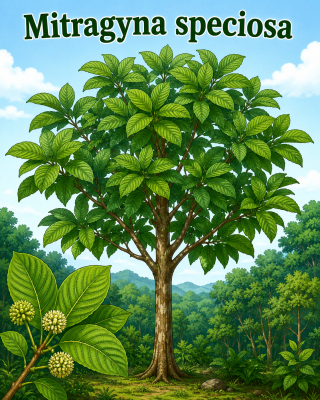
The mitragynine in kratom and other other medicinal substances it contains interacts with a number of central nervous system receptors. It is also a modulatory molecule for the following enzyme pathways:
- Keap-1-Nrf2
- Superoxide Dismutase / SOD
- Catalase / CAT
CAT is another antioxidant enzyme that converts free radicals like hydrogen peroxide into water and oxygen. When CAT is either depleted of inactivated it can lead to oxidative stress, mitochondrial dysfunction, and neuron death. As such, CAT is a focal point in the treatment of neurodegenerative diseases. Kratom helps to modulate CAT along with other neuroprotective enzymes in the body.
- Glutathione-S-Transferase / GST
GST acts as a cellular defense against neurodegenerative disease. It maintains a balanced redox response while using glutathione to neutralize toxic substances in the body and reactive compounds. When GST is impaired and glutathione becomes depleted, neuron damage and cellular death proceeds much more rapidly. Kratom slows neuron damage by protecting GST.
Dosing is important when working with kratom to treat neurodegenerative diseases. Very high doses can be counterproductive (over 12 grams per day). Cycling among the various vein colors and strain types can also be a valuable strategy to use to get the most out of kratom for neurodegenerative disease. Start with a dose of 500 mg up to 4 times per day and double the dose daily until you find a dose that functions to reduce symptoms of neurodegeneration and pain.
Also note that Salvia divinorum is a much more powerful kappa-opioid agonist herb than kratom. If you are trying to heal a disease like MS that involves demyelination of the nerve tissues, the Salvinorin A might be an essential treatment that can help prevent the progression of the disease.
On the other hand though, kratom is not just a kappa-opioid receptor agonist. It interacts with mu-, kappa-, and delta-opioid receptors, it has healing enzyme-pathway effects, and it also has dopaminergic, serotonergic, and adrenergic effects on the nervous system. It is a very broad-spectrum nervous system tonic, and in traditional use, it was administered as a panacea for certain diseases because it has this very broad-spectrum effect on the nervous system. Each vein-color (red, green, yellow, white) and strain (typically named for the location where it was grown), has a different effect, at least in terms of anecdotal experience with these various kratom-types. We recommend that patients with neurodegenerative disease work with this plant medicine as a dialogue with multiple groves of kratom trees from different areas of Southeast Asia, each one coming from a different latitude which changes its effects just slightly. Use at least 3 different kratom vein-colors (red, green, or yellow are best) like a triangulation tool (like something you might use for navigation on a boat) for bringing the patient’s energy field back into the body slowly over the course of long-term treatment.
Resources:
• Hossain, R. et al. (2023). A Critical Review of the Neuropharmacological Effects of Kratom: An Insight from the Functional Array of Identified Natural Compounds. Retrieved June 4, 2026 from https://pmc.ncbi.nlm.nih.gov/articles/PMC10648626/
• Annuar, N. A. K. et al. (2024). An insight review on the neuropharmacological effects, mechanisms of action, pharmacokinetics and toxicity of mitragynine. Retrieved June 4, 2026 from https://www.sciencedirect.com/science/article/pii/S0753332224000155
• Tavakoli, H. R. et al. (2016). Kratom: A New Product in an Expanding Substance Abuse Market. Retrieved June 4, 2026 from https://pmc.ncbi.nlm.nih.gov/articles/PMC6373705/
• Bowe, A. and Kerr, P. L. (2024). Endogenous Opioid Activity as the Mechanism of Action for Mitragyna speciosa (Kratom): The Current State of the Evidence. Retrieved June 4, 2026 from https://pubmed.ncbi.nlm.nih.gov/38874729/
• Eastlack, S. C. et al. (2020). Kratom–Pharmacology, Clinical Implications, and Outlook: A Comprehensive Review. Retrieved June 4, 2026 from https://pmc.ncbi.nlm.nih.gov/articles/PMC7203303/