The ADHD-Trauma Connection
 The Sphinx at Giza in Egypt is a good depiction of the riddle of dissociation -- the wild animal that is also a civilized man...
Trauma is an underlying cause of ADHD. We address the idea of trauma including what trauma is and models of trauma that are helpful in releasing the trauma permanently, but in this discussion, I’d like to address the specifics of ADHD and how ADHD symptoms often resolve when a person is working with sacred indigenous medicines like psilocybin, Ayahuasca, Iboga, or Sapito.
By far, the sacred medicine that seems most important as far as ADHD treatment is concerned is psilocybin. I say this because psilocybin is relatively easy to work with and it is friendly. Both Iboga and Ayahuasca are less accessible to average people and they can sometimes have a harder edge. So I’m going to use psilocybin as an example medicine for ADHD and talk about the model of ADHD that acknowledges that the human psyche is made up of a number of sub-personalities. These sub-personalities can also be referred to as “parts” of a person. “Parts” tend to arrange themselves in cliques.
Click here to schedule a health coaching session with us.
Let’s say that something traumatic happened to you when you’re a child. Hypothetically, let’s say that you suffered birth trauma while you were being born. Maybe you became lodged in the birth canal for several hours. Maybe your mother was terrified and in a lot of pain. As a result of this trauma on your very first day of life, you have suffered from symptoms of trauma since you were born. Almost any situation that we might imagine can be traumatic under the right circumstances. What’s traumatic to one person may not be traumatic to another person. As such, trauma is subjective. Some people might refer to trauma as “stress”, but essentially trauma and stress are the same things. So everyone experiences trauma and stress, but some people can process their trauma and stress while other people, for one reason or another, are unable to process trauma and stress. Maybe there’s too much trauma and stress that happens all at once. Or maybe you lack pieces of information that would help you process your stress and trauma and release it. Or perhaps you have a physical issue or even a nutrient deficiency (such as a deficiency of amino acids, or B vitamins) during a critical period of time when there is a great deal of stress and trauma. As a result, trauma / stress gets trapped in the body and this trauma disrupts your experience of the present-tense, including focus, and your ability to be restful. When a traumatic event occurs, the body tries to process the right-brain experience by observing and analyzing the traumatic material with the left-brain. Normally, when a person is healthy and in a safe environment, the right-brain, body-centric material passes to the left-brain and then back again to the right-brain during Rapid Eye Movement (REM) sleep to process stressful and traumatic events that happened during the day. Eye movements that go from right-to-left and left-to-right, back-and-forth, help the brain move the traumatic experience from back and forth from right-hemisphere to left-hemisphere until a sense of resolution about the event is established. Resolution ultimately happens when a person is able to see meaning and purpose in the event and put words to it. The trauma / stress is then integrated into the personal narrative and life goes on. But if the trauma / stress is not integrated properly for some reason, it will tug at the consciousness for attention, much like a child, until it can be released.
Click here to buy Cure ADHD Now: The No-Nonsense Guide to Plants, Vitamins, and Minerals That Are Scientifically and Anecdotally Proven to Cure ADHD.
When a traumatic event is resolved and it becomes meaningful, a person’s sense of connection to the bigger whole is preserved. Their life story can easily be told with a beginning, a middle, and an end. The traumatic event can also be told as a story with a beginning, a middle, and an end. But when a traumatic event is stored in the body / right-brain because it cannot, for one reason or another, be analyzed to a point of resolution by the left-brain for integration into the personal narrative, a person experiences a sense of disconnection from self and from others and also from the Universe. This is one way to describe dissociation. Another way to describe dissociation is to say that traumatic experiences are like stories that we are a part of that have no beginning, middle or end. Traumatic experiences are stories that are hard to tell because we experience them as though they’re happening right now, over and over again. Trauma is whatever a person (adult or child) has a hard time reckoning with. For a child, trauma might involve being bullied for example. Bullying might occur one time or many times, but no matter what, if it was traumatic and unresolved, the feeling of being bullied can be triggered at any time. When the bullying sequence gets triggered, it feels as though the bullying has always been happening since the beginning of time and that it will always be happening. A person who feels this sense of timelessness or a sense of identity that’s wrapped around a sense of low-self esteem or a lack of self-confidence, for example, is likely getting triggered by ugly traumas that are not fully conscious and that have not been fully resolved to a point where the person can tell the whole story of being bullied as something that happened in the past and that is no longer happening now. Dr. Richard Schwartz developed the theory of sub-personalities as it is most famous today in modern talk-therapy. He calls it Internal Family Systems therapy, but in fact, the theory that the normal human psyche is made up of sub-personalities or “parts” comes from hypnotherapy. And actually, to be fair, the idea of “parts” is actually shamanic. Shaman for centuries have done soul retrievals to bring back parts of a person’s essence that has gotten trapped in “eddies” of consciousness, which causes physical as well as mental illness. Essentially, according to this theory of consciousness, everyone, including normal, functional, healthy individuals have multiple personalities. Modern humans are all made up of multiple personalities. We develop these personalities in order to fluently blend in to different social settings that have very different rules about behavior. For example, I might “front” with or embody a specific sub-personality or clique of personalities when I’m at a place of worship. This clique of sub-personalities doesn’t say bad words and they all know when to sit and when to stand and what to do in that setting. I can then walk across the street to my kid’s school and embody a very different sub-personality or clique of sub-personalities. I might use strong words with my kid’s teacher or I might make off-color jokes at the PTA meeting to earn social credits with a particular group of friends. The rules of PTA and school-related activities is different and I don’t consciously think about the contradictions in my attitudes or behaviors because I literally am not my Core Self in any of these settings. Modern humans are built out of multiple sub-personalities and to have this type of psychology is really efficient in terms of moving from one social setting with one set of rules to another social setting with a very different set of rules. But having multiple sub-personalities can get us into trouble if we have strong internal conflicts among our various sub-personalities. Some people end up with multiple personality disorder if one or more of their sub-personalities is a major conflict with another sub-personality. If this happens, one or more sub-personality may be placed in exile and be inhibited from participation in the unconscious goings on in the person’s life. Some sub-personalities may take on the role of protection of the other, more vulnerable sub-personalities that receive trauma-based wounds. The Protector parts put up a forcefield and use various tactics to prevent the traumatized individual from consciously having access to traumatic memories. These cliques of sub-personalities tend to resolve their conflicts together, leading to integration of all of the 2 or more parts that are involved. “Firemen” are sub-personalities that have been assigned the task of distracting the consciousness of a person from traumatic memory content at all cost. Firemen put out the fires that can happen if a traumatic memory becomes suddenly conscious for a split second. Firemen will do anything to distract a person from their trauma and even go so far as to suggest the use of drugs or sex or reckless behaviors to distract conscious awareness away from traumatic, unconscious content. “Exiles” are vulnerable parts of us that have suffered emotional wounds that were too painful for us to experience fully at the moment when they occurred. Protector parts and firemen tend to work to protect exiles from being discovered. Thus, exiles represent parts of our energy field that are trapped in cages that both protect the exile and restrict them, essentially creating more conflict as time goes on.
Click here to subscribe to the Living Database!
ADHD and Trauma
When we assist people with psilocybin trips and do integration therapy, it’s common for ADHD to actually manifest as a Protector sub-personality that provides distractions and a lack of focus to the consciousness so that traumatic content can remain unconscious. Some people do one psilocybin trip and their trauma is brought into conscious awareness, usually as an emotion that they feel in the body, sometimes attached to a memory and sometimes not. Some people do many trips with psilocybin and eventually confront their ADHD as a very strong Protector sub-personality that puts up a smoke screen in the form of a riddle. Often, ADHD patients get enamored with solving the riddle, which is a distraction from the underlying unconscious content. Men are anatomically built to be able to not feel their emotions if they don’t want to, but both men and women can encounter this type of “Riddler” that produces a distraction during a psilocybin trip that halts progress toward integration of the underlying trauma that necessitates the presence of this Riddling Protector part. For example, one client who had been stuck in a human trafficking ring could not gain access to memories of what he was required to do as someone who had been trafficked for almost 7 years as a child. Before doing mushroom trips, he would get angry with his wife for expecting him to deliver memories that he swore he could not find. But his wife wasn’t requiring him to find memories or any specific type of content, so his anger was not grounded in reality. Over the course of time, it became apparent that there was a Protector personality that expected that others had an expectation for him in regard to the content of his trips. This man was quite experienced with psilocybin by the time this Protector personality stepped forward so, with some guidance, he was able to see how focusing on other people’s purported expectations kept him from focusing on the negative emotions that function as a portal to these memories that might set him free from ADHD symptoms.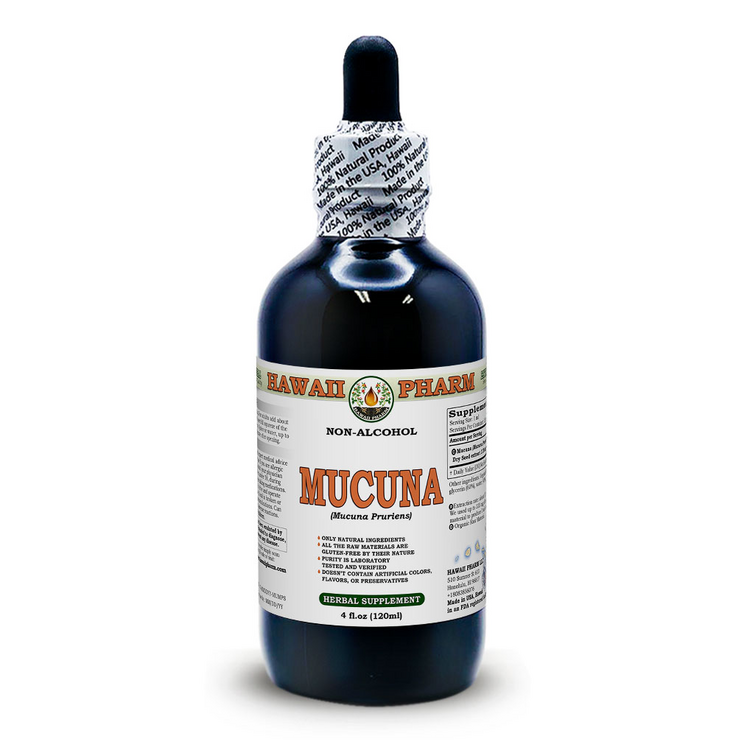
Click here to buy Hawaii Pharm's Mucuna pruriens tincture.
People who work with the sacred medicines like psilocybin don’t always have to try as hard as this man did to get to the underlying memories and experiences that cause ADHD symptoms. Often, the underlying trauma is relatively small and straightforward. Once it’s resolved, the ADHD symptoms go away forever. But for those with a more complicated trauma-history that’s either conscious (known) or unconscious (unknown), ADHD sometimes IS the Protector personality. Distraction and an inability to focus is the antidote to having to focus on painful material. Psilocybin-based trauma work at this moment in history, is all about feeling emotions that were too challenging to feel and experience at the moment when a traumatic event happened. For a lot of people, an inability to focus and hyperactivity prevents them from having to feel negative emotions that have been stored in the body from past, traumatic events. No one with ADHD consciously knows that they’re distracted and unfocused because of a traumatic event. The whole point of the distraction is to experience it consciously as something that’s beyond the patient’s control. This keeps the distraction firmly in place as a mechanism of protection against material that seems to be too frightening or difficult for the ADHD patient to process and then release. Psilocybin slows down the whole process of thinking and feeling so that ADHD patients can observe themselves. Psilocybin also acts as a Guide to help people who submit to it find solutions to seemingly unsolvable problems.Psilocybin for ADHD
Though some people use psilocybin microdosing as a strategy to overcome ADHD, full-trips / macrodosing is often more effective. Better still is the combined use of microdosing and full-trips to release underlying trauma that serves to keep ADHD symptoms in place. Most parents of ADHD kids are not willing to work with the sacred medicines, but we have worked with families who have successfully used psilocybin to help kids overcome ADHD. One young girl (age 12) had chronic pain issues and on a mushroom trip, she was surrounded by ghouls who laughed at her. But it wasn’t the cartoonish ghouls who troubled her, but the Grim Reaper who kept egging them on. In this girl’s unconscious mind, she was constantly surrounded by ghoulish fiends who were making fun of her chronic pain and her inability to focus and this seemed to be at the center of her issues on an unconscious level. In fact though, it was her fear of death (due to chronic pain), personified by a small, 2-dimensional Grim Reaper who was constantly cracking jokes about this poor girl inside this girl’s unconscious mind. This character, a part of the girl herself, and all of these ghouls acted to protect her from pain by keeping her focused on jokes rather than the fear of dying. Her psilocybin trip focused on addressing the Grim Reaper and integrating him as a part of herself that served a purpose – to distract her from physical pain (an issue that she and I would have to work on at a later trip). Another man who had suffered with ADHD symptoms for many decades discovered at one point that he had an Inner Squirrel whose job was to do nothing but point out random details to his conscious mind about the environment. This man had suffered ritual abuse as a young child and the Inner Squirrel (as he referred to this part of himself), would help the man’s consciousness focus elsewhere on anything outside of his body so as to survive situations involving severe sexual abuse. These are extreme examples. Some people with ADHD though, take mushrooms once to do a full-trip and their ADHD goes away forever. The mushrooms rewire the brain and release some underlying trauma and that’s it! Psilocybin helps the brain slow down and it builds new neural connections so it helps people step away from their own patterns and objectify the person’s behavior to themselves. Psilocybin gets thoughts out of hopeless dead-ends to build new roads through which a thought can find new territory or old territory and get out of endless loops. Psilocybin specifically helps the consciousness calm down and become quieter so that a person can hear and see and feel unconscious material that normally resists coming to the surface. For those with ADHD, it’s usually important to have someone listen to the content of their trips for full integration because putting unconscious material into words consciously is important for a modern human being. In ADHD clients who have trouble discovering the root emotional cause underlying their symptoms, integration therapy helps them find portals into unconscious material if ADHD doesn’t resolve within the first few full-trips plus a few months of microdosing.
Click here to learn more about the DreamLight.app, a guided meditation and brain-entrainment tool for natural trauma-release.
Summary
Trauma is an underlying problem for most people with ADHD, but trauma can be released. When trauma is released, it is released permanently. In fact, trauma isn’t “released” but rather “integrated”. Sub-personalities in exile are brought back to the Core Self. When a person’s energy is brought back into the body after being in exile, the body can heal more completely than if you simply take medicines to heal the structures of the body. But in order to heal trauma, it’s also important to heal body structures like dopamine receptors that might be damaged. If there is an underlying infection that has damaged the brain or the body in some way, healing this problem can make it easier to integrate sub-personalities and restore energy to the body so that the body can heal itself and ward off infection more readily in the future.ADHD is a disorder that can be cured permanently. Not everyone has to work with all of the medicinal agents that we suggest, but some people do. Most people (kids or adults) with ADHD benefit from working with psilocybin or another sacred medicine, but this work can be and often is more productive when the body has been healed to some extent using the Mucuna pruriens protocol and the Cinchona officinalis protocol.