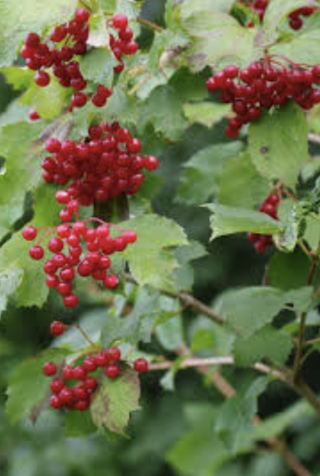
Viburnum opulus: Medicinal Substances
Viburnum opulus contains the following medicinal substances:
Click here to schedule a health coaching session with us.
- Scopoletin
Scopoletin is a coumarin that produces an antispasmodic action on smooth muscles. This medicinal substance, which is found in a number of different plants (e.g. Morinda citrifolia, Aegle marmelos, Erycibe obtusifolia, Lasianthus lucidus, Melia azedarach, Sinomonium acutum, Solanum lyratum, Convolvulus prostratus) has powerful medicinal effects:
- Lowers blood pressure
- Lowers fever
- Calms the thyroid gland (antithyroid)
- Shrinks cancerous tumors (antiproliferative)
- Anti-inflammatory
- Heals neurological issues
- Mental health promoting effects (anti-dopaminergic)
- Antifungal
- Antibacterial
- Antiviral
- Antiprotozoal
- Natural treatment for tuberculosis (antitubercular)
- Protects the liver
- Antioxidant
Click here to buy Viburnum opulus oil.
- Chlorogenic Acid
Chlorogenic acid has an antimicrobial, anti-inflammatory, and antioxidant effect on the body. Chlorogenic acids can have a healing effect on the gastrointestinal system. They are derived from quinic acids.
- Catechins and Epicatechin
These substances have astringent activity in the body.
- Viopudial
This medicinal substance also has an antispasmodic action on smooth muscles.
- Viburnin
Viburnin is a bitter medicinal compound that also has antispasmodic activity.
- Aesculetin
Aesculetin is a coumarin that acts as an antispasmodic.
- Ursolic Acid
Ursolic acid is an anti-inflammatory via COX-2 inhibition and NF-kappaB modulation.
- Salicin
Salicin, a precursor to salicylic acid that has anti-inflammatory effects on the body, is found in the leaves and branches of Viburnum opulus. Other salicin-containing herbs like white willow are also powerful healers.
- Quercetin
- Kaempferol
- Valerianic Acid
Valerianic acid has sedative and antispasmodic properties. It binds to GABA receptors and it has an activity similar to benzodiazepines. In high doses, valerianic acid is an anti-convulsive agent.
Click here to buy Viburnum opulus / Cramp Bark tincture.
Resources
Kundu, S. et al. (2024). Scopoletin alleviates high glucose-induced toxicity in human renal proximal tubular cells via inhibition of oxidative damage, epithelial-mesenchymal transition, and fibrogenesis. Retrieved April 25, 2026 from https://pubmed.ncbi.nlm.nih.gov/38709349/
Joshi, H. et al. (2021). Review on Scopoletin: A Phenolic Coumarin with Its Medicinal Properties. Retrieved April 25, 2026 from https://ijpsr.com/bft-article/review-on-scopoletin-a-phenolic-coumarin-with-its-medicinal-properties/#:~:text=Scopoletin%20has%20a%20number%20of%20pharmacological%20activities%2C,Antibacterial%20*%20Antifungal%20*%20Antitubercular%20*%20Antioxidant
Al-Harbi, L. N. et al. (2022). Cinchona officinalis Phytochemicals-Loaded Iron Oxide Nanoparticles Induce Cytotoxicity and Stimulate Apoptosis in MCF-7 Human Breast Cancer Cells. Retrieved April 25, 2026 from https://pmc.ncbi.nlm.nih.gov/articles/PMC9565860/#:~:text=Plant%2Dbased%20nanoparticles%20have%20the,phytosterols%20have%20also%20been%20identified.
Gbotolorun, S. C. et al. (2018). Quinine inhibits ovulation and produces oxidative stress in the ovary of cyclic Sprague-Dawley rats. Retrieved May 8, 2026 from https://pmc.ncbi.nlm.nih.gov/articles/PMC6306975/
Keri, R. S. and Patil, S. A. (2014). Quinoline: A promising antitubercular target. Retrieved May 8, 2026 from https://www.sciencedirect.com/science/article/abs/pii/S075333221400136X