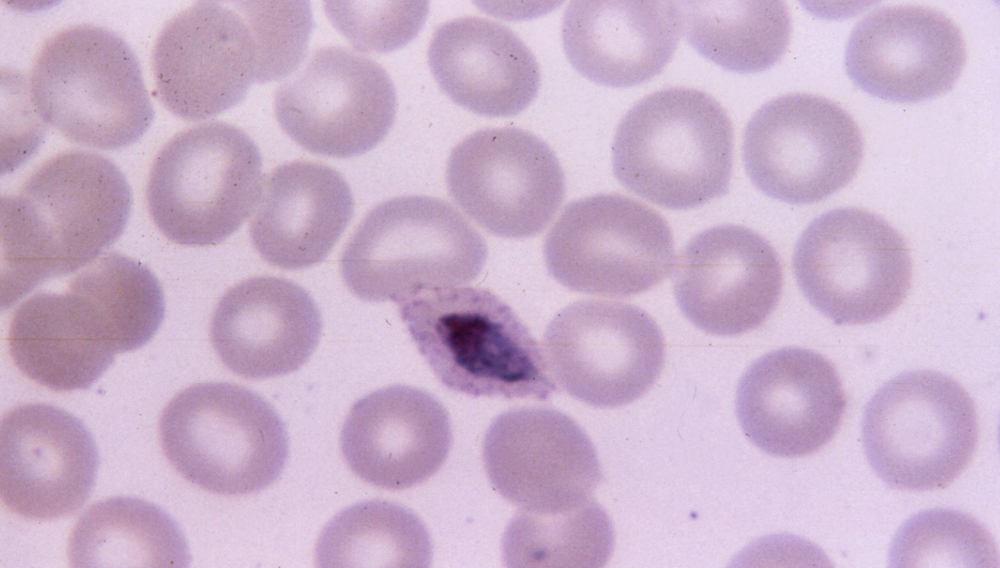
Malaria / Plasmodium spp.
Malaria causes high fevers, shaking chills, headaches, vomiting, diarrhea, muscle pain, and fatigue, symptoms that typically appear seven to eighteen days after the infective bite, though some Plasmodium species can establish dormant liver-stage infections that reactivate months years later. If left untreated, malaria can progress to a severe disease including manifestations such as cerebral malaria with coma, severe anemia, acute organ failure, or death.
Despite being both preventable and curable, malaria kills hundreds of thousands of people each year. The vast majority of deaths happen among young children in sub-Saharan Africa. That this continues to be the case is not a failure of knowledge or available tools. It is a failure of access, infrastructure, and sustained political and economic commitment to overcoming this disease.
Malaria is not transmitted person-to-person. It requires the bite of an infected female Anopheles mosquito as the vector. The parasite passes from the mosquito's salivary glands into the human bloodstream during a blood meal, travels to the liver, and begins the cycle of development and replication that eventually produces the blood-stage infection responsible for symptoms.
Click here to schedule a health coaching call with us.
The Five Plasmodium Species
Five species of Plasmodium are capable of infecting humans, with meaningfully different clinical profiles.Plasmodium falciparum is the most dangerous type of malaria infection. It is responsible for the majority of severe malaria cases and deaths globally. It occurs most often in sub-Saharan Africa. It is the species most associated with cerebral malaria and the rapid progression to life-threatening disease that characterizes untreated severe infection.
Plasmodium vivax is the most geographically widespread species outside Africa, with a particularly important biological characteristic: it can form dormant liver-stage parasites (hypnozoites) that reactivate weeks or years later, after the initial infection. Plasmodium vivax infections can produce clinical relapses long after the primary illness appears to have resolved.
Plasmodium malariae causes a milder, more chronic infection and it can persist in the bloodstream for decades at very low levels, occasionally causing nephropathy through immune complex deposition.
Plasmodium ovale, like Plasmodium vivax, forms hypnozoites capable of relapse.
Plasmodium knowlesi is primarily a parasite of macaques in Southeast Asia but it has increasingly been recognized as a cause of human malaria. Plasmodium knowlesi is capable of rapid replication cycles that can produce severe disease if untreated.
Click here to subscribe to the Living Database!
Prevention and Treatment
Malaria is a fascinating disease, but it gets little attention in the developed world. Malaria infection, for example, can be intentionally produced in order to cure cancer. And certain psychiatric diseases are linked to malaria infection. While this little known fact was a pattern that malaria-doctors in the tropical world could easily see in patients of all ethnicities, most English-speakers are hardly made aware of the dangers of certain antimalarial drugs in conventional medicine like mefloquine that are known to cause suicidal ideation in individuals who are not depressed at all prior to taking the drug.So the topic of malaria as a parasite is complex and it takes us into the realm of cures for serious, life-threatening diseases like cancer as well as into the realm of psychiatric illness and the interplay between mind and body.
Conventional prevention methods rely on interrupting mosquito-to-human transmission using insecticide-treated bed nets, indoor residual spraying, mosquito repellents, and, for travelers to endemic regions, chemoprophylaxis with antimalarial drugs. Some of these antimalarial drugs are toxic and some cause severe psychiatric issues that can lead to severe depression and suicide. None of these measures of prevention is perfect in isolation, and their effectiveness depends on consistent, correct use in populations that often lack reliable access to them.
Treatment of malaria is effective when initiated early. The choice of antimalarial agent depends on the infecting species, disease severity, and local drug resistance patterns. Artemisinin-based combination therapies (ACTs) are the current standard of care in conventional medicine for uncomplicated Plasmodium falciparum malaria. For Plasmodium vivax and Plasmodium ovale, primaquine or tafenoquine are prescribed in addition to blood-stage treatment to eradicate hypnozoites and prevent relapse, a step that requires screening for G6PD deficiency, since both drugs can cause hemolysis in deficient individuals. Severe malaria requires intravenous artesunate, a drug that’s derived from the natural cure for malaria known as Artemisia annua. Quinine is another conventional medicine treatment that’s derived from the Cinchona officinalis tree.
Malaria is curable. The deaths that continue to occur disproportionately in children under five, in the world's most resource-constrained settings, are a measure of what remains to be done, not of what is medically possible.
Artemisia annua and Cinchona officinalis for Malaria
Artemisia annua (also known as Qing Hao in Traditional Chinese Medicine) and Cinchona officinalis are an effective combination herbal remedy for malaria when given at the proper dose. Artemisia is administered at a dose of 5 grams daily (given in two separate doses, morning and night, of 2.5 grams) in adults and in children over 5 years of age. In children under 5 years of age, the Artemisia annua dose is 2.5 grams daily given as 1.25 grams twice per day. Artemisia annua should be prepared as a tea.Click here to buy Artemisia annua / Qing Hao.
Cinchona officinalis (also known as quina) should be administered at a dose of 0.25 mg per kilogram of the patient’s body weight. It should be prepared as a decoction that simmers in water for 15 to 20 minutes. The decoction can then be added to sweetened bubbly water and drunk throughout the day, ideally over the course of 8 hours so that the body is constantly receiving a small amount of quinine and other medicinal agents.
Click here to buy Cinchona officinalis / Quina.
Methylene Blue for Malaria
Methylene blue is an over-the-counter, tried-and-true malaria inhibitor that can be used to both prevent and treat Plasmodium falciparum and Plasmodium berghei. However, liver-stage Plasmodium berghei that is already established is unaffected by methylene blue.
Methylene blue can be given with Cinchona officinalis for 3 days at the proper dose (see below) in place of Artemisia annua, but the Artemisia annua remedy should then be resumed for 1 to 2 weeks before administering methylene blue for malaria again.
Below is a dosing chart for methylene blue 1% given as drops from a standard dropper. If you have a higher concentration of methylene blue, note that at 0.1%, 1 mL of methylene blue equals 1 mg and you must do the math to figure out the proper dose at the concentration that you’re administering.
Administer 1 mg per kilogram (or per 2.2 pounds) of the patient’s body weight of methylene blue 1%:
- Body Weight: 50 kg/110 lbs: 1 mg/kg dose = 50 mg/day or 100 drops/day
- Body Weight: 55 kg/121 lbs: 1 mg/kg dose = 55 mg/day or 110 drops/day
- Body Weight: 60 kg/132 lbs: 1 mg/kg dose = 60 mg/day or 120 drops/day
- Body Weight: 65 kg/143 lbs: 1 mg/kg dose = 65 mg/day or 130 drops/day
- Body Weight: 70 kg/154 lbs: 1 mg/kg dose = 70 mg/day or 140 drops/day
- Body Weight: 75 kg/165 lbs: 1 mg/kg dose = 75 mg/day or 150 drops/day
- Body Weight: 80 kg/176 lbs: 1 mg/kg dose = 80 mg/day or 160 drops
- Body Weight: 85 kg/187 lbs: 1 mg/kg dose = 85 mg/day or 170 drops/day
- Body Weight: 90 kg/198 lbs: 1 mg/kg dose = 90 mg/day or 180 drops/day
- Body Weight: 95 kg/209 lbs: 1 mg/kg dose = 95 mg/day or 190 drops
- Body Weight: 100 kg/220 lbs: 1 mg/kg dose = 100 mg/day or 200 drops/day
Click here to buy Methylene Blue 1%.
Ekebergia capensis for Malaira
Ekebergia capensis is a medicinal of herb of importance in tropical, sub-Saharan areas of Africa. It can be used to treat malaria and intermittent fever, as well as gastrointestinal problems, parasites, body pain, reproductive issues in women, respiratory disease, and skin disease. Ekebergia capensisi extract is an acetylcholinesterase inhibitor. It is a pain-reliever and an anti-inflammatory as well as an anti-fungal, antibacterial, antiviral, anthelmintic, antischistosomal, antitrypanosomal, antimycobacterial (it has activity against tuberculosis), anti-hypertensive, antioxidant, antimalarial, antiplasmodial, and anticancer herb.
Chlorine Dioxide Solution / CDS / Miracle Mineral Supplement / MMS for Malaria
Chlorine dioxide solution / CDS, also known as Miracle Mineral Supplement / MMS is an at-home treatment for malaria. Other Reactive Oxygen Species (ROS) medicines like food grade hydrogen peroxide 3%, methylene blue, or ozone therapy as well as Artemisia annua (combined with Cinchona officinalis) are beneficial. These medicines all work through a similar mechanism of action. Patients should be consistent in giving themselves the proper dose of CDS / MMS, but also administer only one reactive oxygen species medicine at a time. It is also necessary to avoid certain antioxidants like vitamin C and foods that might cancel out the effects of the CDS / MMS within 30 minutes before and after administration. CDS / MMS can be a powerful treatment with some scientific backing to warrant its use but as with other ROS medicines, CDS / MMS requires some reading and education in order to use it properly for self-treatment at home.
Click here to subscribe to the Chlorine Dioxide Protocols Database.
Parasites: Self-Treatment and Prevention - BUY THE eBOOK HERE!!!
Resources
Saison, N. et al. (2022). Rapid and Specific Action of Methylene Blue against Plasmodium Transmission Stages. Retrieved March 23, 2026 from https://pmc.ncbi.nlm.nih.gov/articles/PMC9786052/ISGlobal (2017). An Old Drug to Combat a Re-Emerging Intestinal Parasite. Retrieved March 17, 2026 from https://www.isglobal.org/en/-/un-antiguo-farmaco-para-combatir-un-parasito-intestinal-reemergente
Microbiology (2024). Dyes could fight intestinal parasites. Retrieved March 17, 2027 from https://ibsal.es/en/dyes-could-fight-intestinal-parasites/
Kumar, R. et al. (2024). Phytopharmaceuticals as an Alternative Treatment against Parasites. Retrieved March 14, 2026 from researchgate.net/publication/372573626_Phytopharmaceuticals_as_an_Alternative_Treatment_against_Parasites
Google Patents (n.d.). Methylene Blue Therapy of Parasitic Infections. Retrieved March 16, 2026 from https://patents.google.com/patent/WO2007038201A1/en
Khanna, V. et al. (2014). Identification and Preservation of Intestinal Parasites Using Methylene Blue-Glycerol Mount: A New Approach to Stool Microscopy. Retrieved March 15, 2026 from https://onlinelibrary.wiley.com/doi/10.1155/2014/672018#:~:text=After%20observing%20various%20parasites%20by,of%20intestinal%20parasites%20%5B9%5D.