Leishmaniasis Treatments in Conventional Medicine and Alternative Treatments That Work for Drug Resistant Leishmaniasis
There are more than 20 species of Leishmania that can be transmitted to humans through the bites of infected female phlebotomine sandflies. It is classified as a neglected tropical disease, which is a designation that reflects as much about the economics of drug development and global health prioritization as it does about the biology of the infection. Between 700,000 and 1 million new cases occur annually across more than 90 countries in the Americas, Africa, and Asia, concentrated almost entirely in poor populations living in tropical and subtropical regions with inadequate housing, malnutrition, and limited healthcare access. No vaccine exists.
Click here to schedule a health coaching call with us.
Forms of Leishmaniasis
Leishmaniasis presents in three distinct forms that differ in their anatomical targets, clinical severity, and health consequences.Cutaneous Leishmaniasis is the most common form of this disease. It produces skin lesions that initially involve papules that develop into ulcers. These can take months to heal and often leave permanent scarring. While not typically fatal, cutaneous leishmaniasis causes significant disfigurement and, in endemic regions where stigma around visible skin disease is common, substantial social and psychological harm.
Mucocutaneous Leishmaniasis represents a potentiallymore destructive health progression, in which the parasite invades the mucous membranes of the nose, mouth, and throat. The resulting tissue destruction can be severe and disfiguring, compromising breathing, eating, and speech. Mucocutaneous Leishmaniasis develops in some patients, particularly those with untreated or inadequately treated cutaneous disease, sometimes years after the initial skin infection appears to have resolved.
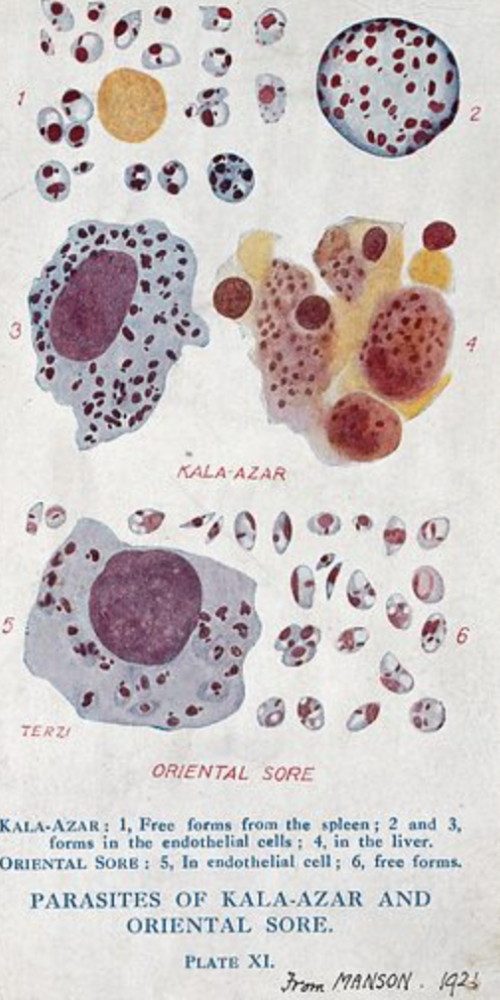
Visceral Leishmaniasis also known as kala-azar, is the most serious form of this disease and is fatal if untreated. The parasite disseminates to the internal organs including the spleen, liver, and bone marrow, producing fever, progressive weight loss, anemia, and profound immunosuppression. The splenomegaly and hepatomegaly that accompany visceral disease can become massive. In the context of HIV co-infection or poor immunity, visceral leishmaniasis behaves as an opportunistic infection and carries particularly high mortality.
Diagnosis of leishmaniasis is confirmed through laboratory methods including microscopic examination of tissue smears, serological testing, and PCR with the choice of method depending on the clinical form suspected and available laboratory resources. Visceral leishmaniasis in particular requires confirmatory testing before treatment, as the drugs used in conventional medicine carry significant risk. This is yet another reason to consider working with natural cures for leishmaniasis and alternative remedies that are often more effective and far less toxic.
Treatment in conventional medicine include liposomal amphotericin B (preferred for visceral disease in many settings due to its effectiveness and tolerability), antimonial compounds (historically first-line but limited by toxicity and drug resistance), miltefosine (an oral agent active against both cutaneous and visceral disease), and pentamidine. Treatment failure, relapse, and drug resistance are real issues with these drugs particularly with the antimonials, against which resistance has become widespread in parts of the Indian subcontinent.
Prevention centers on personal protection against sandfly bites using insecticide-treated nets, repellents, and protective clothing along with vector control measures. For canine leishmaniasis, which forms the domestic reservoir for Leishmania infantum transmission in Europe, the Mediterranean basin, and Latin America, vaccination and insecticidal collars for dogs are part of an integrated control strategy that addresses this issue.
Click here to subscribe to the Living Database!
Artemisia annua for Leishmaniasis
Artemisia annua (also known as Qing Hao) is used as a vital natural remedy for other protozoal infections like malaria. This herb is safe for use in dogs, though some sources falsely claim that it is not.Artemisia annua contains artemisinin, a substance that has strong, dose-dependent activity against Leishmania infantum. Artemisinin works not just by killing the protozoa, but also through immune modulation of the host. Harmful inflammatory responses to Leishmania infantum protozoa are as dangerous as the infection itself, but with higher doses of Artemisia annua and correspondingly high concentrations of artemisinin, the magnitude of therapeutic effects increases.
Click here to buy Artemisia annua / Qing Hao.
Methylene Blue and Red Light Therapy for Cutaneous and Mucocutaneous Leishmaniasis
Cutaneous leishmaniasis (Leishmania amanoensis) has been successfully treated using methylene blue and red light exposure to affected areas of the skin. Methylene blue is administered orally and the patient then waits for 2 hours and then they administer 30 minutes of red and infrared light (that includes light within the 660 wavelength) to the area of the body affected. Methylene blue should be administered twice daily in the morning and again in the evening. Red light therapy can also be administered twice daily about 2 hours after methylene blue doses are given.Click here to buy a Red Light Therapy Device.
Red light therapy devices exist to treat mucus membranes throughout the body in the nose, the vagina, the rectum, and other areas. As such, this type of therapy using methylene blue and red light can be administered to the mucous membranes as well.Methylene blue and red light therapy is something that anyone can do at home. It is a powerful natural remedy for mucocutaneous and cutaneous forms of leishmaniasis that works, at least in part, through the production of reactive oxygen species medicines in the body.
Administer 1 mg per kilogram (or per 2.2 pounds) of the patient’s body weight of methylene blue 1%:
- Body Weight: 50 kg/110 lbs: 1 mg/kg dose = 50 mg/day or 100 drops/day
- Body Weight: 55 kg/121 lbs: 1 mg/kg dose = 55 mg/day or 110 drops/day
- Body Weight: 60 kg/132 lbs: 1 mg/kg dose = 60 mg/day or 120 drops/day
- Body Weight: 65 kg/143 lbs: 1 mg/kg dose = 65 mg/day or 130 drops/day
- Body Weight: 70 kg/154 lbs: 1 mg/kg dose = 70 mg/day or 140 drops/day
- Body Weight: 75 kg/165 lbs: 1 mg/kg dose = 75 mg/day or 150 drops/day
- Body Weight: 80 kg/176 lbs: 1 mg/kg dose = 80 mg/day or 160 drops
- Body Weight: 85 kg/187 lbs: 1 mg/kg dose = 85 mg/day or 170 drops/day
- Body Weight: 90 kg/198 lbs: 1 mg/kg dose = 90 mg/day or 180 drops/day
- Body Weight: 95 kg/209 lbs: 1 mg/kg dose = 95 mg/day or 190 drops
- Body Weight: 100 kg/220 lbs: 1 mg/kg dose = 100 mg/day or 200 drops/day
Click here to buy Methylene Blue 1%.
Parasites: Self-Treatment and Prevention - BUY THE eBOOK HERE!!!
Resources
Morua, E. et al. (2025). Standardized Artemisia annua Exhibits Dual Antileishmanial Activity and Immunomodulatory Potential In Vitro. Retrieved March 24, 2026 from https://pmc.ncbi.nlm.nih.gov/articles/PMC12568091/Cabral, F. V. et al. (2022). Preclinical Investigation of Methylene Blue-mediated Antimicrobial Photodynamic Therapy on Leishmania Parasites Using Real-Time Biolumninescene. Retrieved March 24, 2026 from https://pubmed.ncbi.nlm.nih.gov/31792979/
Vasco-Dos-Santos, D. R. et al. (2025). Light, Dyes, and Action: Photodynamic Inactivation of Leishmania amazonensis Using Methylene Blue, New Methylene Blue, and Novel Ruthenium-Based Derivatives. Retrieved March 24, 2026 from https://pubmed.ncbi.nlm.nih.gov/41463483/