What is brown adipose tissue?
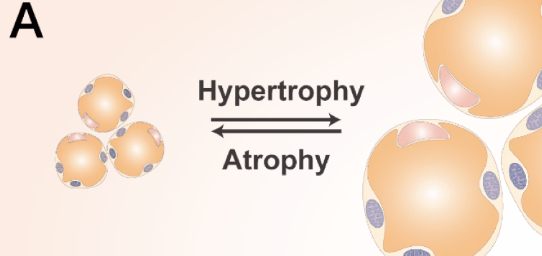
Brown adipocytes contain a number of lipid droplets in contrast to white adipocytes which contain just one lipid droplet. And brown adipocytes contain a higher number of iron-containing mitochondria, giving the brown adipocytes their characteristic color. As we’ve already discussed, iron is precious in the human body and brown adipocytes are structures in the body that contain some of this mineral.
There are two types of brown adipose tissue. One shares a common embryological origin with muscle cells. The other develops from white adipocytes that are stimulated by the sympathetic nervous system. Brown adipocytes that arrive from sympathetic nervous system stimulation are interspersed within white adipose tissue and they are named “beige” or “brite” (as in “brown in white”).
Click here to schedule a health coaching session with us.
Brown adipose tissue is abundant in newborn babies and in hibernating animals. It is also found in metabolically active adult humans, but its prevalence diminishes with age.Brown adipocytes contain a much higher number of mitochondria which contain iron. The iron is what gives mitochondria its brown color. Brown adipose tissue contains more capillaries than white adipose tissue which supply the brown fat with oxygen and nutrients. These capillaries also distribute the body heat throughout the body that’s produced by brown fat.
Brown adipose tissue is a special type of fat that burns lipids and glucose in the body in order to generate heat. The production of heat in brown adipose tissue causes a “non-shivering thermogenesis” that plays an important role in keeping body heat regulated in cold environments.
In one study, mice were injected with Salmonella typhimurium. They developed a fever and scientists observed whether the fever was in any way related to brown adipose tissue. What they observed was that some of the white adipose tissue turned into brown adipose tissue as a result of infection. Scientists speculated that brown adipose tissue played a role in maintaining an elevated body temperature (a fever) after the development of an infection, but it is also possible that brown adipose tissue works to release fat-soluble vitamins that are needed in order to fight the infection.
Fever is generally type of defense mechanism by a host against an infectious pathogen. We’ll talk more about this later, but let’s just assume for now that a fever is a defensive strategy and we’ll discuss psychogenic fevers in greater detail later. During a fever, the core body temperature is increased. There are several factors involved in this core body temperature change, but brown adipose tissue plays a part in this fever-response. How it contributes is still being studied, but it appears that fatty-acid oxidation in brown adipose tissue plays a critical role in the fever response.
Click here to learn more and subscribe to the Living Database now.
Resources:
• Li, M. et al. (2024). Brown adipose tissue facilitates the fever response following infection with Salmonella enterica serovar Typhimurium in mice. Retrieved January 26, 2026 from https://pubmed.ncbi.nlm.nih.gov/39128824/
• Krysa, S. J. and Brestoff, J. R. (2024). Brown fat fuels the fire in fever. Retrieved January 26, 2026 from https://www.sciencedirect.com/science/article/pii/S0022227524001639
• Szentirmai, E. and Kapas, L. (2018). Brown adipose tissue plays a central role in systemic inflammation-induced sleep responses. Retrieved January 26, 2026 from https://journals.plos.org/plosone/article?id=10.1371/journal.pone.0197409
• Benson, H. et al. (1982). Body temperature changes during the practice of g Tum-mo yoga. Retrieved February 20, 2026 from https://ui.adsabs.harvard.edu/abs/1982Natur.295..234B
• Zunin, I. D. et al. (2025). Effects of Tummo Meditation and Niguma Yoga on Brain Activity. Retrieved February 20, 2026 from https://pmc.ncbi.nlm.nih.gov/articles/PMC12679118/#:~:text=Following%20Tummo%20and%20Niguma%2C%20a,in%20alpha%20percent%20power%20reported.
• Edgerton, D. S. et al. (2006). Insulin’s direct effects on the liver dominate the control of hepatic glucose production. Retrieved February 20, 2026 from https://pmc.ncbi.nlm.nih.gov/articles/PMC1359060/
• Levine, H. (2024). REM sleep: What is it, why is it important, and how you can get more of it?M Retrieved February 20, 2026 from https://www.health.harvard.edu/staying-healthy/rem-sleep-what-is-it-why-is-it-important-and-how-can-you-get-more-of-it#:~:text=How%20to%20get%20a%20good,will%20sleep%20better%20that%20night.