Whipworm / Trichuris trichiura
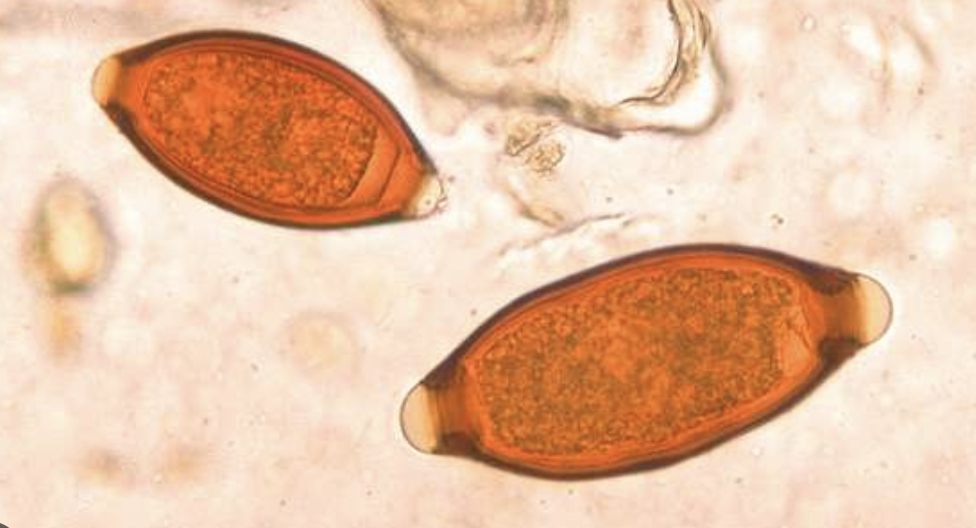
The worm can live for up to four years in humans. Diagnosis is made by the characteristic lemon-shaped eggs on stool microscopy, though sensitivity is limited at low parasite burdens and as noted elsewhere, diagnosis in conventional medicine is not very accurate and can delay treatment.
Several years ago, I had a 10 week old kitten who was taken away from the mother cat and caged, but also left in the home in a separate room from the mother cat. The kitten would cry out and the mother cat would cry back to her (per the previous owners who told us this story before the kitten became ours). Lydi and I already knew that this had been like torture for this baby animal. When the kitten arrived at our farm in Mexico, she was very ill and stunted. She developed severe diarrhea shortly after she arrived and I was able to observe that she had large whipworms in her stool.
I didn’t know if this kitten would survive. I gave her a mebendazole-quinfamide combination treatment that didn’t seem to help at all. I also tried ivermectin but without success. One day, after having a dream about castor oil as a potential treatment for her, I decided to try it because I’d run out of options. I accidentally gave her a very high dose of castor oil. Though I initially felt terrible about having overdosed this little kitten on castor oil, this was what ultimately cured her. After the castor oil treatment, she finally recovered. She was stunted physically and is still a small kitty, but she is intelligent and recovered intellectually it seems.
Click here to schedule a health coaching session with us.
Organic, cold-pressed castor oil given orally is likely to work on a number of different types of intestinal worms by clearing out the intestines. In humans, castor oil can be administered to produce an intestinal purge and then a different medicinal agent is given afterward to help rebuild a healthy bacterial flora in the intestines.Children and adults over 12 years of age may be given 1 to 4 tablespoons (15-60 mL) of castor oil as a one-day treatment.
Children 2 years to 12 years of age can be given 1 to 3 tablespoons (5 to 15 mL) of castor oil as a single daily dose. Do you administer castor oil to children under 2 years of age.
Camelina sativa oil is a cooking ingredient that can be used as a natural remedy for castor oil-induced diarrhea. It does not produce constipation or vomiting. Rather, Camelina sativa is given after the castor oil to help the intestines recover properly. Pickled water from pickled vegetables is another traditional remedy for castor-oil induced diarrhea. The water from pickled vegetables does not produce constipation or vomiting either. Pickled water restores the tight junctions between mucosal cells according to research and it also suppresses oxidative stress. Pickle-water helps to restore a healthy bacterial flora in the gut after the intestinal worms and other pathogens are removed by the castor oil.
Click here to buy Castor Oil.
Albendazole and mebendazole are treatment options for whipworm infection in conventional medicine, though cure rates using these medicines are lower than for other soil-transmitted helminths. Every 28 days, administer albendazole at a dose of 200 mg twice daily (400 mg total) for 3 days. Or, every 28 days give mebendazole at a dose of 250 mg twice daily for 3 days in a row.As with the other intestinal worms, Nicotiana rustica / wild Tobacco can be used to get rid of whipworms. You can administer Nicotiana rustica daily or every other day or on whatever schedule feels right to you in the form of Ambil, a paste made in the Amazon for ceremonial use.
Click here to learn more and subscribe to the Living Database now.
Parasites: Self-Treatment and Prevention - BUY THE eBOOK HERE!!!
Resources:
• ISGlobal (2017). An Old Drug to Combat a Re-Emerging Intestinal Parasite. Retrieved March 17, 2026 from https://www.isglobal.org/en/-/un-antiguo-farmaco-para-combatir-un-parasito-intestinal-reemergente
• Microbiology (2024). Dyes could fight intestinal parasites. Retrieved March 17, 2027 from https://ibsal.es/en/dyes-could-fight-intestinal-parasites/
• Williamson, S. M. et al. (2009). The Nicotinic Acetylcholine Receptors of the Parasitic Nematode Ascaris suum: Formation of Two Distinct Drug Targets by Varying the Relative Expression Levels of Two Subunits. Retrieved March 18, 2026 from https://pmc.ncbi.nlm.nih.gov/articles/PMC2705655/
• Bondarenko, V. et al. (2023). Structural Elucidation of Ivermectin Binding to alpha-7nAChR and the Induced Channel Desensitization. Retrieved March 18, 2026 from https://pmc.ncbi.nlm.nih.gov/articles/PMC10020961/#:~:text=Ivermectin%20(IVM)%20is%20a%20positive%20allosteric%20modulator,NMR**%20*%20**Molecular%20dynamics%20simulations%20(MD%20simulations)**